
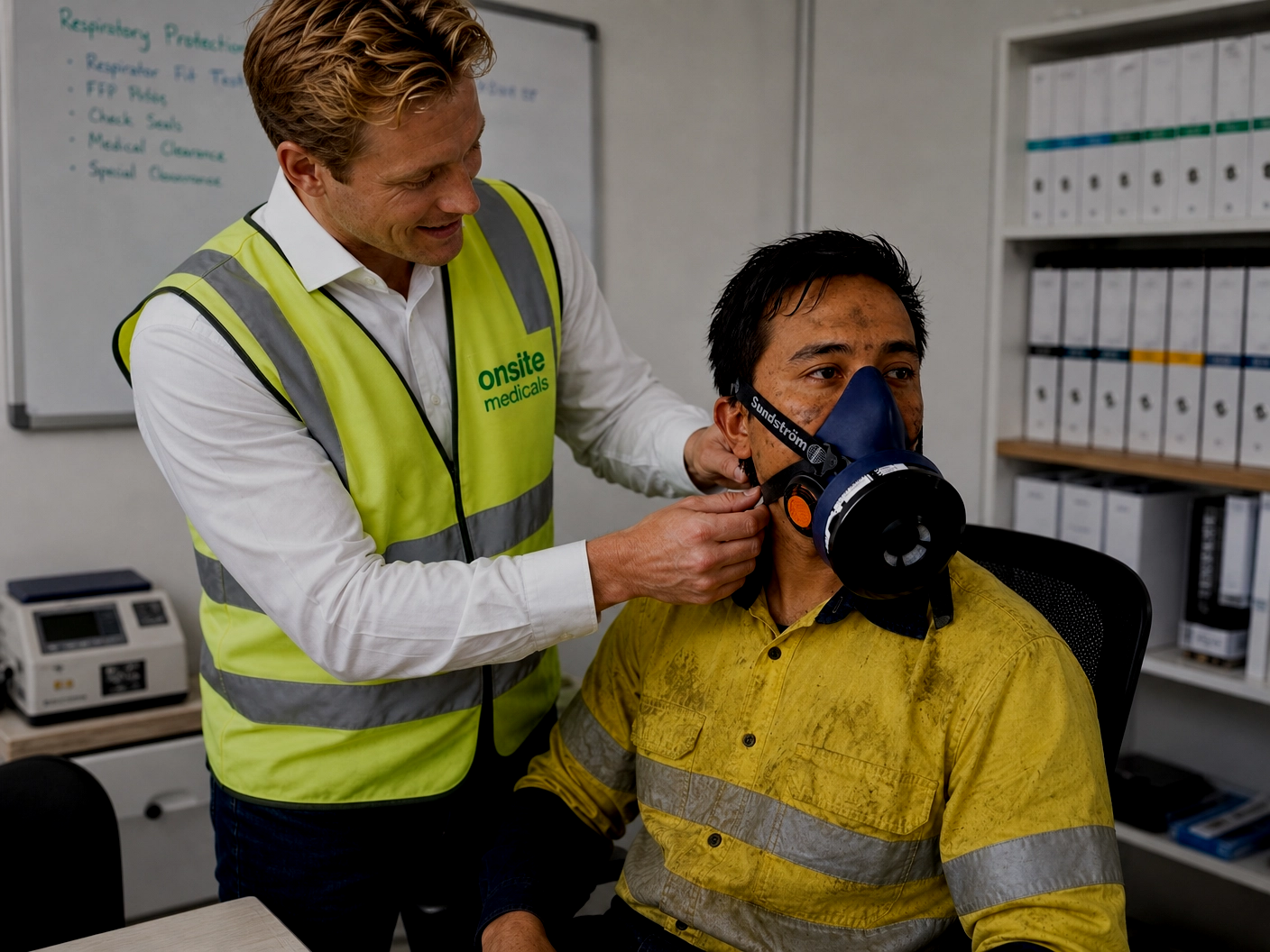
On-Site Respirator & Mask Fit Testing Sydney & NSW
Professional Fit Testing For Your Workplace

Need mobile fit testing in Sydney to avoid sending your team away from site?
Onsite Medicals provides mobile, on-site respirator and mask fit testing for workplaces across Sydney, Newcastle, Wollongong and regional NSW.
We provide quantitative fit testing for employees using P2, N95, P3 and other tight-fitting respirators, with testing conducted at your workplace to minimise employee downtime and disruption.
Our service is designed for workers who use respiratory protective equipment (RPE) as part of their work, including tight-fitting air-purifying respirators, P2/N95 disposable respirators, P3 respirators, half-face respirators and full-face respirators.
Need affordable fit testing for a team? Our on-site service can be a convenient and cost-effective option when multiple workers require testing.
Book on-site fit testing today or request a quote for your workplace.
What is fit testing?
Respirator fit testing checks whether a tight-fitting respirator forms an effective seal around an individual worker's face.
A respirator can only provide its intended level of protection when it fits the wearer correctly. A poor seal can allow contaminated air to enter around the edges of the respirator.
A fit test is different from a routine seal check or fit check. A seal check is performed by the wearer each time the respirator is put on, while a fit test is a formal assessment of whether a particular respirator fits the individual worker.
For workplaces where respiratory protective equipment is required, fit testing forms an important part of an effective respiratory protection program.
SafeWork NSW identifies fit testing as an important requirement for tight-fitting respiratory protective equipment and recognises qualitative and quantitative fit-testing methods under AS/NZS 1715:2009.
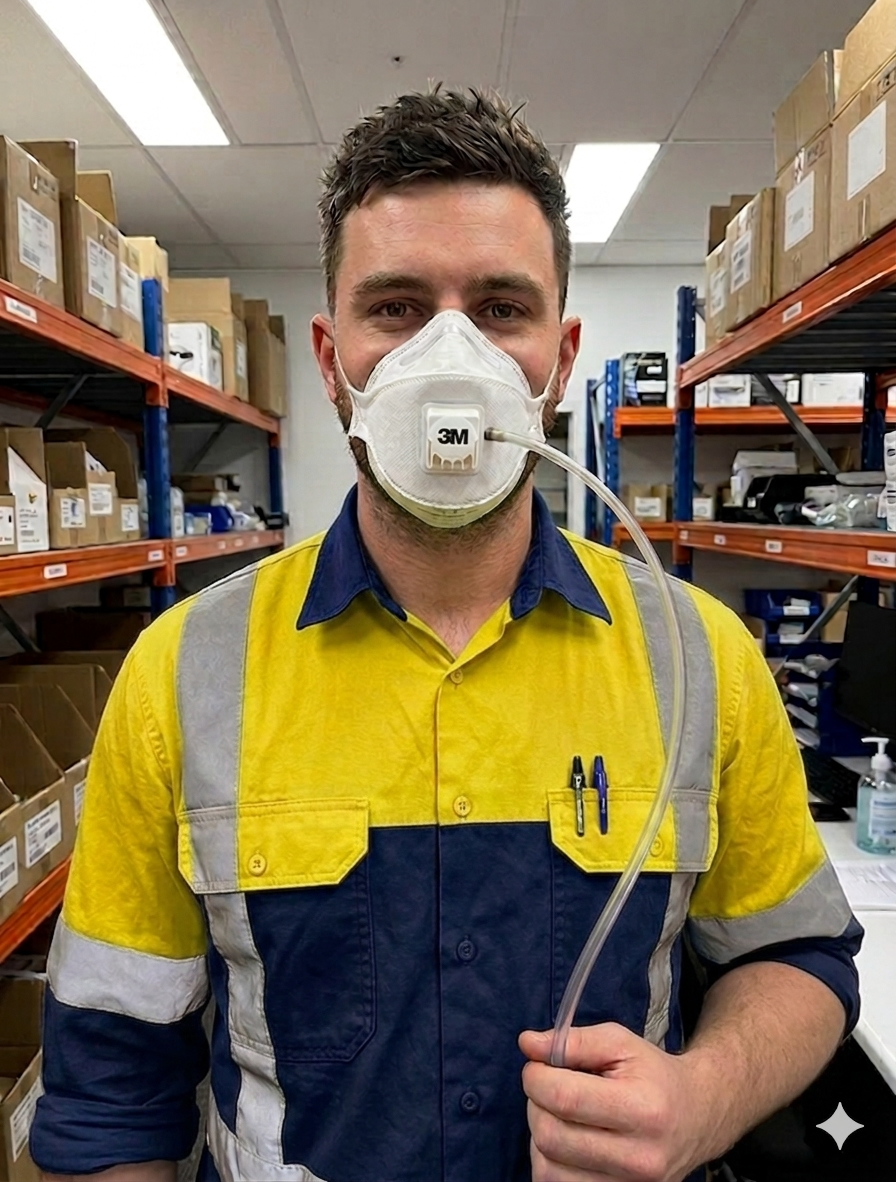
Quantitative respirator fit testing
We use quantitative fit testing with a TSI Portacount 8048 to objectively measure how well a tight-fitting respirator seals to the individual worker's face.
The quantitative fit test produces a numerical fit factor, providing an objective result rather than relying on the wearer to detect a test substance.
Quantitative fit testing can be used with suitable tight-fitting respirators, including:
P2/N95 disposable respirators
P3 respirators
Half-face respirators
Full-face respirators
Other suitable tight-fitting respiratory protective equipment
The worker completes a series of movements and breathing exercises while the Portacount measures particles inside and outside the respirator to assess the effectiveness of the seal.
Quantitative fit testing provides documented respirator fit results for each worker and respirator tested. Testing should be conducted using the type, make and model of respirator the worker is expected to use on the job.
Who needs respirator fit testing?
Fit testing is particularly important for workers who are required to use tight-fitting respiratory protective equipment as part of their work.
This can include workers in:
Construction & Civil
Workers who may be exposed to respirable dust, including silica-containing dust, during construction, demolition, cutting, grinding, drilling and other high-dust activities.
Healthcare
Healthcare workers and students who are required to wear P2/N95 respirators as part of infection prevention and respiratory protection programs.
NSW Health guidance states that fit testing assesses the quality of a health worker's respirator seal.
Manufacturing
Workers using respirators where exposure to dust, fumes, particles or other airborne contaminants requires respiratory protection.
Maintenance & Trades
Electricians, mechanics, maintenance workers, technicians and other tradespeople who may require tight-fitting respiratory protection.
Government & Local Council
Council and government workers whose duties require respiratory protective equipment.
Education & Student Placement
Students undertaking healthcare, medical, dental or other placements where a particular respirator is required.
Respirator fit testing for silica & asbestos dust exposure
Respirator fit testing is particularly important where workers rely on tight-fitting respiratory protective equipment as part of controls for airborne contaminants.
This can include work involving:
Crystalline silica
Concrete and masonry dust
Cutting and grinding
Drilling
Demolition
Remediation work
Construction dust
Asbestos
Other respirable particulates
Where a tight-fitting respirator is used, the respirator needs to form an effective seal against the worker's face. Fit testing helps confirm that the selected respirator provides an appropriate fit for that individual.
Fit testing should form part of a broader respiratory protection program rather than being treated as a replacement for other controls. Where hazardous airborne contaminants are present, workplaces should follow the relevant risk assessment, control measures and NSW WHS requirements.
How does a respirator fit test work?
Our on-site respirator fit testing process is straightforward and designed to minimise disruption to your workplace.
Preparing for Your Respirator Fit Test
Employers should supply, or workers should bring, the respirator they are required to wear when working.
It is recommended that alternative masks or respirators are available for the session in case a worker fails the initial test and another suitable respirator needs to be assessed.
Workers are required to be clean shaven where facial hair could interfere with the respirator's sealing surface. Facial hair between the face and the sealing surface can prevent a tight-fitting respirator from forming an effective seal.
1. Select the respirator
The worker brings the respirator they are required to use at work.
The respirator should be the same type, make and model that the worker is expected to use for their job.
2. Check the fit and seal
The worker puts on the respirator and adjusts it correctly. A proper seal is essential before the fit testing process begins. A user seal check should also be performed each time the respirator is put on to confirm that the respirator is seated correctly and there are no obvious leaks. A user seal check is different from a formal quantitative fit test.
3. Complete the quantitative fit test
The worker performs a series of movements and breathing exercises while the quantitative fit test is conducted.
The fit tester uses the Portacount equipment to measure particles inside and outside the respirator and determine the effectiveness of the seal.
4. Results and reporting
Each worker's fit test result is instantly documented in our portal and downloadable for your workplace records.
The results provide a clear record of the respirator tested and the outcome. Results can then be retained as part of the workplace's respiratory protection and compliance records.
Tight-Fitting Respirators and Respiratory Protective Equipment
Tight-fitting respirators rely on a seal between the respirator and the wearer's face.
This includes many types of air-purifying respirators, including disposable P2/N95 respirators, P3 respirators, half-face respirators and full-face respirators.
Where a respirator operates through negative pressure during normal breathing, maintaining an effective face seal is particularly important because air can otherwise enter through gaps around the respirator.
The type of respirator selected should be appropriate for the workplace hazard, exposure and respiratory protection program.
Fit testing confirms whether the selected tight-fitting respirator achieves the required fit for the individual worker.
How long does fit testing take?
A typical individual respirator fit test takes approximately 10 minutes, depending on the respirator and worker. For workplaces with multiple employees, we organise the testing schedule so your team can be tested efficiently on-site. If you have a larger workforce, contact us for an on-site fit testing quote based on your number of workers and location.For larger teams, we can coordinate the testing schedule with your workplace to help minimise disruption and keep your employees moving through the process efficiently.
When should workers have a fit test?
Workers should complete fit testing before using a tight-fitting respirator where fit testing is required.
Fit testing should also be repeated when a change could affect the seal or suitability of the respirator, such as:
A change in respirator type
A change in respirator make or model
A change in respirator size
Changes to the worker's facial characteristics
Other circumstances that may affect the respirator seal
The appropriate testing frequency is governed by the relevant WHS requirements, respiratory protection program and applicable standards.
Employers should consider fit testing whenever a worker is issued a different respirator make, model or size, or when changes to the worker's facial characteristics may affect the seal.
For specific NSW workplace requirements, refer to the relevant SafeWork NSW guidance and AS/NZS 1715:2009.
What happens if a worker fails a fit test?
A failed fit test means the respirator did not achieve the required fit for that worker.
This doesn't necessarily mean the worker cannot use respiratory protection.
The fit tester can help identify whether the issue relates to:
Respirator size
Respirator model
Positioning
Adjustment
Facial hair
Compatibility with other PPE
The respirator's ability to form an effective seal
Where appropriate, another suitable respirator can be tested.
A failed fit test should be resolved before the worker relies on that respirator for work requiring respiratory protection. The worker may need a different size, model or type of respirator before a successful fit test can be achieved.
The objective is to identify a respirator that provides an effective fit for the individual worker.
Affordable workplace respirator fit testing
We provide on-site respirator and mask fit testing for workplaces across Sydney, Newcastle, Wollongong and regional NSW. Our mobile service allows your employees to complete their fit testing at your workplace, reducing travel and disruption to your operations.
We offer competitive half-day and full-day rates, with workplace fit testing available from as little as $29 per test. We can provide a tailored quote based on your location and number of workers, particularly for workplaces outside Sydney.
Onsite fit testing across Sydney & NSW
Why make your workers travel to a clinic when fit testing can come to you?
We provide fit testing services across a range of industries including:
Construction
Manufacturing
Civil works
Maintenance and trades
Government and council works
Health care workers
University Students on clinical or practical placements
Any workplace handling chemicals
We service Sydney, Newcastle, Wollongong and all regional locations throughout NSW.
For businesses with multiple workers requiring testing, on-site fit testing can reduce travel time, employee downtime and the administration involved in sending workers to different appointments.
P2, N95 & other respirator fit testing
We provide fit testing for a range of tight-fitting respiratory protective equipment, including suitable air-purifying respirators and disposable respirators used in workplace environments.
Depending on your workplace requirements, we can test respirators including:
P2 and N95 disposable respirators
P3 respirators
Half-face respirators
Full-face respirators
SCBA
The respirator being tested should be the type, make and model that the worker is expected to use for their job.
If a worker fails a fit test, the respirator may not be providing an adequate seal. The worker should not simply continue using an unsuitable respirator. The fit, size or model should be reviewed and another suitable respirator can be tested.
We service workplaces across areas including:
Sydney CBD
Western Sydney
South Western Sydney
South Sydney
Northern Sydney
North Western Sydney
Eastern Suburbs
Parramatta
Penrith
Liverpool
Campbelltown
Blacktown
Newcastle
Central Coast
Wollongong
Regional NSW - Mid West, South Coast Central tablelands, Coffs Harbour, Port Macquarie
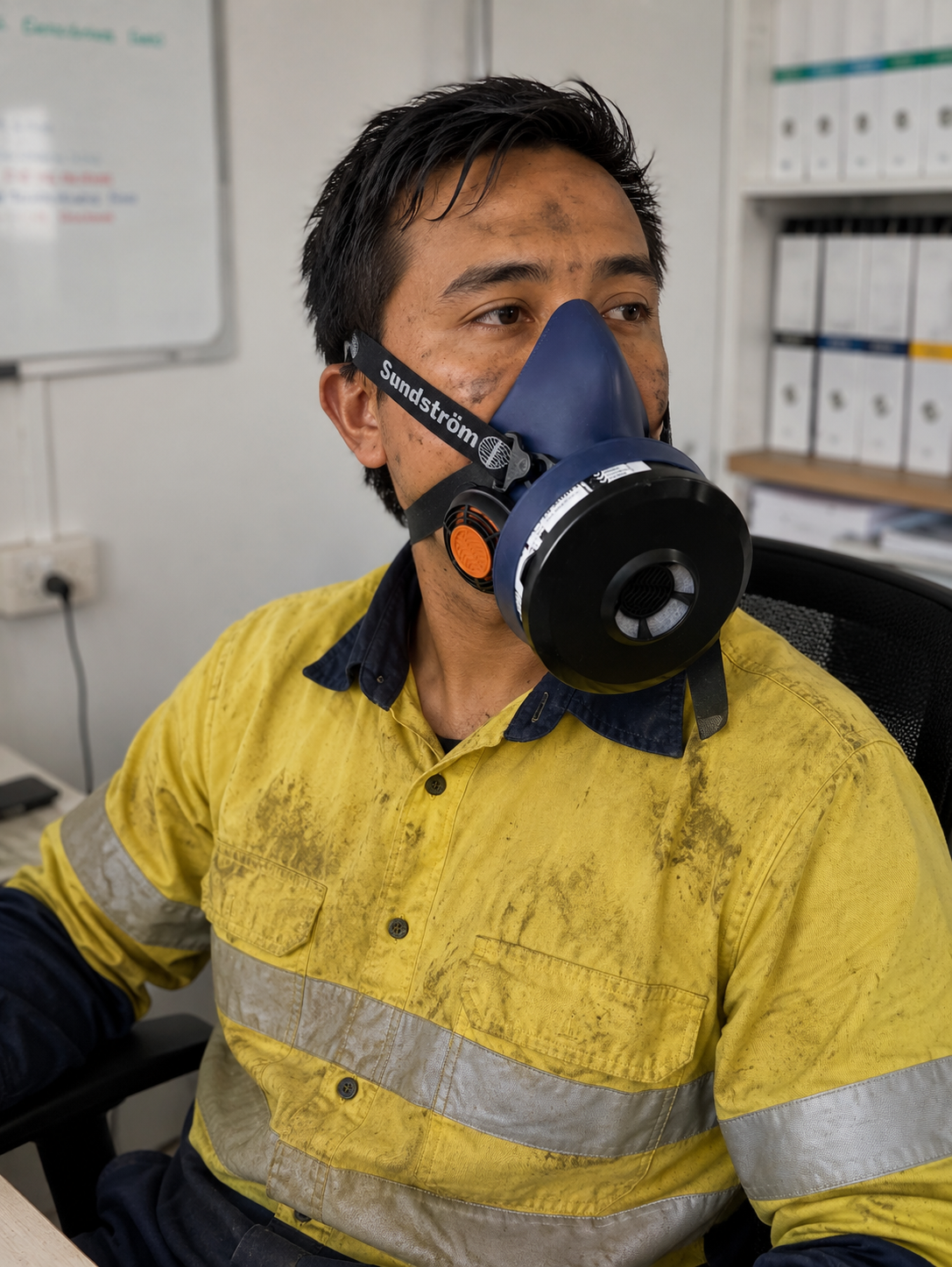
Need fit testing for your team? Contact Onsite Medicals to arrange on-site respirator fit testing at your workplace.