
Silica Medicals Sydney & NSW - Onsite Silica & Asbestos Medicals
Mobile silica medicals completed at your workplace

Silica & Asbestos Medicals NSW | Onsite Workplace Health Assessments
Need silica medicals for your workers? Onsite Medicals provides mobile respirable crystalline silica (RCS) health monitoring across Sydney and NSW.
Our registered medical practitioners and occupational health team come directly to your workplace, allowing your workforce to complete their assessments onsite rather than travelling to a clinic.
One medical covering silica and/or asbestos
If your workers are exposed to both respirable crystalline silica and asbestos, our medical can cover clearance to work in exposure to both hazardous substances where clinically and operationally appropriate. That means less travel, less disruption and simpler administration for your business. Don’t be billed twice for a hazardous dusts legislated medical.
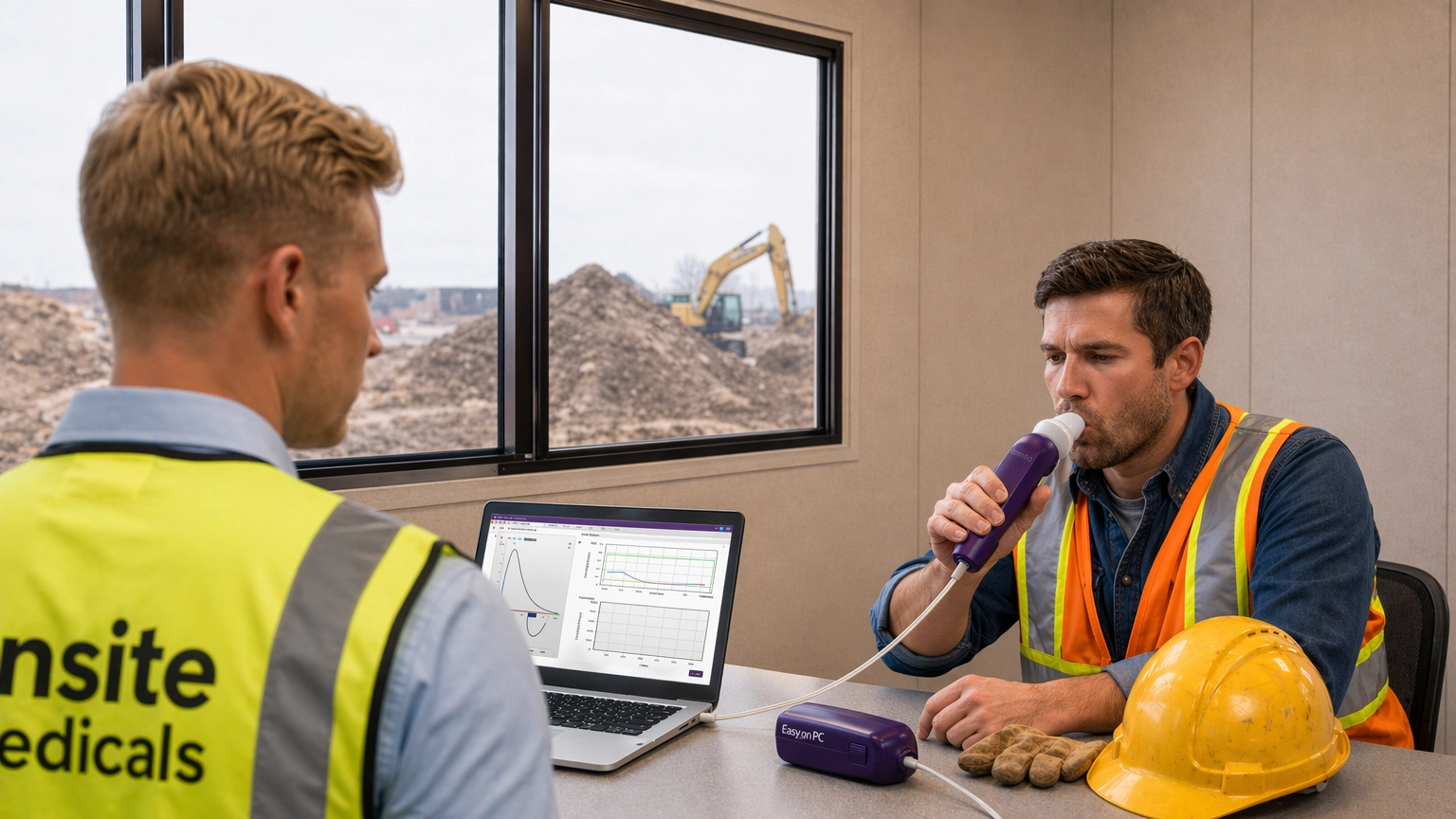
What is a silica medical?
A silica medical, also called crystalline silica health monitoring, is a health assessment for workers who may be at significant risk of illness because of ongoing exposure to respirable crystalline silica dust.
Respirable crystalline silica (RCS) is the fine dust produced when materials containing crystalline silica are processed. Activities such as cutting, drilling, grinding, crushing, sanding and polishing can generate respirable particles that can be inhaled deep into the lungs.
Crystalline silica can be found in materials including:
Concrete
Brick
Sandstone
Natural stone
Manufactured and construction materials
Other products containing crystalline silica
Workplace exposure to RCS can cause serious diseases including silicosis, lung cancer and kidney disease.
Health monitoring is an important part of protecting workers who are at significant risk from ongoing exposure.
Who needs a silica medical?
A worker may require silica health monitoring where their work involves respirable crystalline silica and there is a significant risk to their health from ongoing exposure.
Higher-risk work can include activities such as:
Cutting concrete, brick or stone
Grinding or drilling silica-containing materials
Crushing or processing silica-containing materials
Tunnelling and excavation
Construction and civil work
Demolition
Mining and quarrying
Stone processing
Other work that generates respirable crystalline silica dust
Workers may also be exposed through activities such as cleaning contaminated work areas or equipment.
Importantly, the requirement for health monitoring is based on the worker's exposure and risk — not simply their job title.
SafeWork NSW states that PCBUs must provide health monitoring where there is a significant risk to a worker's health from ongoing exposure to respirable crystalline silica.
If you're unsure whether your workers require health monitoring, speak with your occupational health provider or occupational hygienist.
What does a silica medical include?
The health monitoring assessment is determined by the registered medical practitioner based on the worker's exposure, medical history and individual circumstances.
Depending on the worker and the health monitoring program, an assessment may include:
Medical and occupational history
The medical practitioner reviews the worker's relevant medical history, occupational history and exposure to respirable crystalline silica.
Respiratory questionnaire
A standardised respiratory questionnaire is used to assess relevant respiratory symptoms and history.
Spirometry
Spirometry measures lung function and can help identify changes in respiratory function.
Physical examination
A physical examination may be performed where clinically indicated and appropriate to the worker's exposure and medical history.
Chest imaging
The PCBU is to advise those they are engaging for silica health monitoring about the level of risk of RCS that their employees are subject to. Onsite medicals assist clients with this at onboarding, as it determines the frequency of X-rays which can be between every 3-5 years.
The imaging requirements for crystalline silica health monitoring include a PA-view chest X-ray that has been reported to ILO classification by a radiologist who is a NOISH accredited B-Reader or is certified on the RANZCR Experts in Occupational Lung Disease List. In NSW, the supervising medical practitioner may also consider more sensitive imaging such as low-dose high-resolution CT where clinically appropriate.
The updated national guidance for medical practitioners, published in May 2026, provides current recommendations for assessing workers exposed to respirable crystalline silica.

We bring the medical to your workplace
Instead of sending your workers to different clinics on different days, our mobile service comes to you.
We can coordinate group silica medicals at: Construction sites, civil worksites, industrial sites, demolition & sites, mining and quarry sites, manufacturing facilities
Remote worksites
Company offices and depots
Our on-site model is particularly useful for businesses with multiple workers requiring health monitoring at the same time.
Why use an onsite silica medical service?
Reduce worker travel
Your employees don't need to spend hours travelling to and from a medical centre.
Reduce operational downtime
Assess your workforce at your workplace and get workers back to their normal duties sooner.
Assess multiple workers together
Group bookings allow your business to coordinate assessments more efficiently.
One point of contact
We coordinate the on-site assessment and reporting process with your business.
Sydney and regional NSW
We service Sydney, Greater Sydney and regional NSW locations.
Silica Health Monitoring Requirements in NSW
Under NSW work health and safety (WHS) laws, Persons Conducting a Business or Undertaking (PCBUs) must provide health monitoring for workers where there is a significant risk to their health from ongoing exposure to respirable crystalline silica (RCS).Health monitoring is an important part of protecting workers who may be exposed to silica dust. It can help identify changes in a worker’s health at an early stage and should form part of a broader workplace risk management program.
SafeWork NSW requires PCBUs to use a registered medical practitioner, such as those at Onsite Medicals with experience in health monitoring to carry out or supervise silica health monitoring. Employers must also obtain the health monitoring report, provide a copy to the worker and retain health monitoring records for at least 30 years.
SafeWork NSW Silica Worker Register
The SafeWork NSW Silica Worker Register (SWR) was established on 1 October 2025. PCBUs are required to notify SafeWork NSW about workers undertaking high-risk crystalline silica processing activities. High-risk silica processing can include activities such as cutting, drilling, grinding and polishing crystalline silica substances where the work is reasonably likely to create a risk to a person's health. PCBUs must register each relevant worker within 28 days of commencing high-risk crystalline silica processing work. Workers only need to be notified to the register once during their employment with that PCBU.
The Silica Worker Register is designed to help identify workers who may require health monitoring and improve the prevention and early detection of silica-related occupational diseases. Employers can access the SafeWork NSW Silica Worker Register here: SafeWork NSW – Silica Worker Register notification. Importantly, being listed on the Silica Worker Register does not mean that a worker has been exposed to dangerous levels of silica dust or has developed a silica-related disease. The register is a preventative and regulatory measure designed to support worker health monitoring.
When Is Silica Health Monitoring Required?
Health monitoring must be provided where there is a significant risk to a worker’s health from ongoing exposure to RCS. This requirement can apply even when workers are using respiratory protective equipment (RPE) to control their exposure. Workers who may require silica health monitoring can include people involved in high-risk processing activities such as: Cutting, drilling, grinding or polishing silica-containing materials. Processing engineered stone or other crystalline silica substances. Construction and tunnelling activities involving silica-containing materials. Workers who regularly work in areas where respirable silica dust may be present.
Workers involved in cleaning dusty work areas or equipment. A PCBU must undertake an appropriate risk assessment to determine whether silica processing is high risk. Factors include the type of processing, the silica content of the material, the frequency and duration of exposure, potential airborne silica concentrations and relevant air or health monitoring results.
Silica Health Monitoring Does Not Replace Dust Controls
Health monitoring is only one part of a comprehensive silica risk management program. It does not replace the requirement to eliminate or minimise exposure to respirable crystalline silica dust. Businesses should continue to apply appropriate control measures, including:
Wet cutting and other dust suppression methods, local exhaust ventilation, effective dust extraction. isolation of dusty processes, appropriate workplace housekeeping, suitable respiratory protective equipment, correct respirator fit testing and fit checking, worker training and supervision and air monitoring where required. SafeWork NSW recommends using effective controls to minimise workers’ exposure to RCS and requires PCBUs to manage silica risks in accordance with their WHS obligations.